Australia records an average of over 17,000 residential house fires every year, with electrical issues cited as the leading cause in many state-level reports. Most Australians think of bushfires or floods when they think of fire risk — but a 2019 Macquarie University research paper found that residential fires contributed to more deaths on average than all natural disasters combined, and that most of those deaths were preventable.
The six leading electrical causes are well-documented, and every one of them has either a warning sign you can learn to spot or a preventative step you can take now. This guide walks through each — with specific advice for Brisbane homeowners, because the mix of character Queenslanders, post-war homes, and modern appliance loads creates a particular risk profile we see repeatedly on callouts.
1. Faulty outlets & appliances
If a power outlet looks visibly worn — cracked plastic, blackening around the socket holes, feels warm to touch — it's likely the wiring inside it is deteriorating too. Pair that with a plugged-in appliance with a frayed cord, and heat can build rapidly at the connection, igniting the wall cavity or the appliance itself.
The fix: replace any damaged outlet as soon as you notice it, and retire appliances with frayed or damaged leads rather than repairing the cord with tape. A licensed electrician can replace an outlet in under an hour. The longer the worn outlet stays in service, the higher the fire risk becomes — this is genuinely not something to defer.
2. Portable heaters
Portable heaters cause more winter house fires than any other appliance class. The manufacturer safety rules matter — follow them:
- •Keep at least 1 metre of clearance from anything combustible — curtains, bedding, furniture, clothing laid out to dry.
- •Place on a solid, flat, stable surface. A heater knocked over by a pet or child during operation is a direct ignition source.
- •Plug directly into a wall outlet, never into an extension cord or power board — heaters draw significant current and overload multi-outlet setups.
- •Upgrade any old coil-element heater. Modern heaters with tilt-protection, over-temperature shutoff, and enclosed elements are dramatically safer.
- •Never leave running unattended, and never run overnight in a bedroom without supervision.
3. Outdated wiring
Older Brisbane homes — particularly Queenslanders built before 1970 and post-war homes built in the 1940s–1960s — often have wiring that's 50+ years old and was never designed for today's electrical loads. Modern households run ducted A/C, multiple fridges, induction cooking, multi-device charging stations, home offices with several computers, and EV chargers in the garage. The 1950s wiring in the ceiling wasn't engineered for that.
Warning signs your home's wiring might be struggling:
- •Flickering lights or intermittent power outages under normal load.
- •Appliances or electrical devices that feel excessively hot in normal use.
- •Shocks or sparks from appliances or outlets.
- •Unexplained burning smells that don't have an obvious source.
- •Circuit breakers that trip repeatedly without an obvious overload.
- •Outlets or switches that feel warm to touch.
If your Brisbane home was built more than 20 years ago and hasn't had a rewire, there's a meaningful chance the wiring is at or past its original service life. A full or partial rewire brings the installation up to current AS/NZS 3000:2018 standards. In the meantime, a licensed safety inspection will flag any immediate risks and give you a prioritised remediation plan.
4. Over-stacked power boards
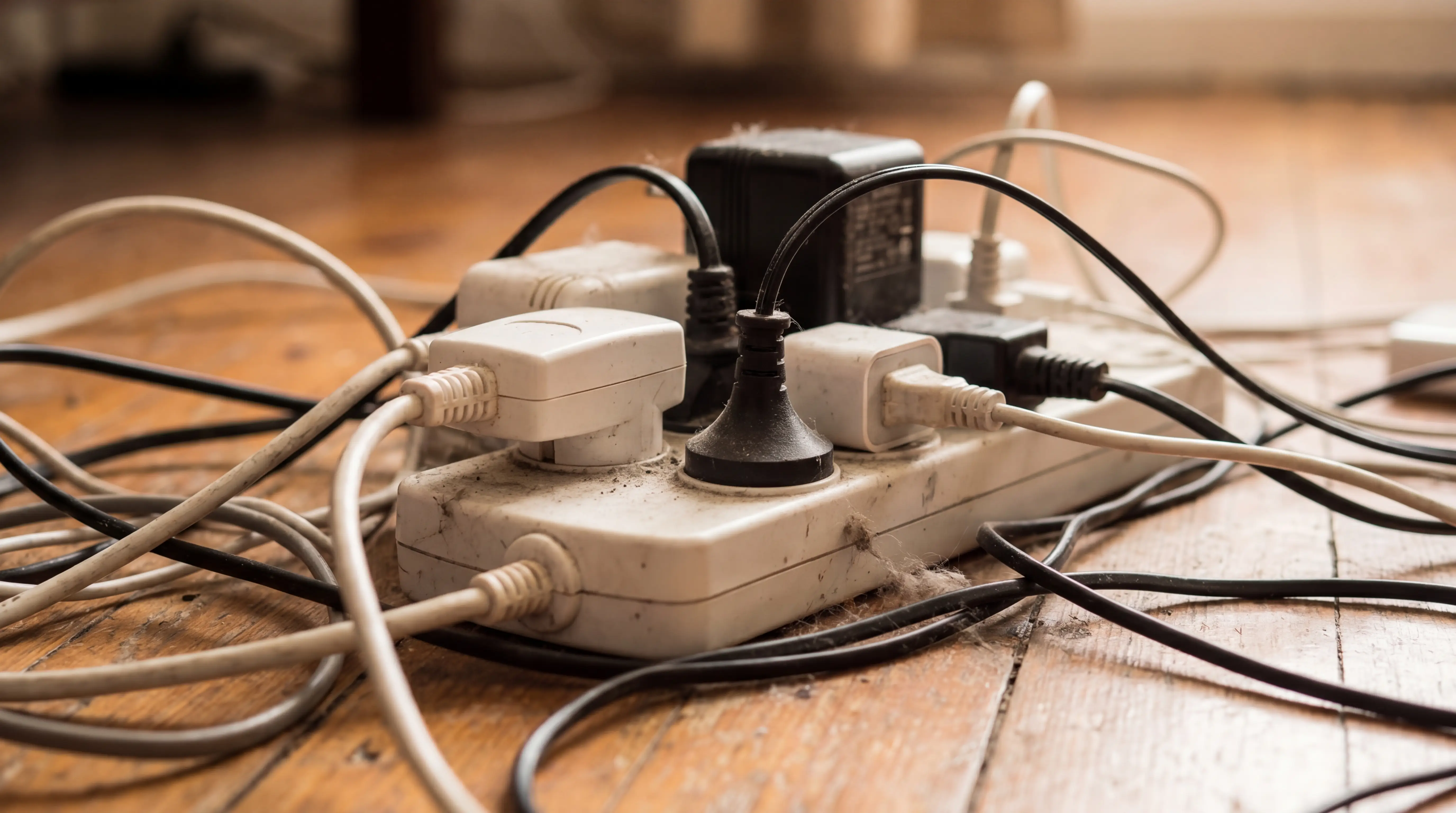
The 'daisy chain' — plugging one power board into another, or chaining extension cords together — is one of the most common causes of house fires and one of the easiest to avoid. Each power board and cord has a maximum current rating. Stacking them means the first one in line carries all the load of everything downstream, often well beyond what it's designed for.
If you don't have enough outlets for your needs, the correct fix is to call a licensed electrician and get additional outlets installed. Adding GPOs is cheap, permanent, and dramatically safer than living with overloaded power boards. If you're renovating anyway, plan for 50% more outlets than you currently think you need — future-you will thank you.
5. Wrong wattage light bulbs
Every light fitting has a maximum wattage rating printed on the fitting or in its instructions. Installing a bulb above that rating — typically attempted to get more brightness — causes the fitting and wiring to heat beyond their design temperature. Over time, insulation in the cable breaks down and the fitting can ignite.
The modern fix is LED. LED bulbs produce the same light as incandescent or halogen at a fraction of the wattage — typically 7–10W for the equivalent of an old 60W incandescent. A lumens-equivalent LED bulb inside the rated wattage of the fitting gives you all the brightness you want without the heat.
6. Faulty circuit breakers
Circuit breakers are the fundamental fire-prevention device in your switchboard. They're designed to trip and cut power when a circuit draws more current than it's rated for — which prevents the wiring in that circuit from overheating. A failed breaker that doesn't trip when it should is a genuine fire risk.
Warning signs of a faulty breaker:
- •A strange burning smell near the switchboard.
- •A breaker that keeps tripping under normal load, or won't stay reset.
- •A breaker that feels warm or hot to touch.
- •Discolouration (yellowing or browning) on the breaker face.
- •An appliance keeps tripping the same circuit even when plugged into different outlets on it.
Any of these calls for a professional inspection. Older switchboards with rewireable ceramic fuses don't have breakers at all — they rely on fuse wire that can fail silently, and they offer none of the electric-shock protection that modern RCD-protected boards provide. If your home has ceramic fuses, a switchboard upgrade is the single most valuable electrical safety investment you can make.
Smoke alarms — your last line of defence
Research cited by Australian fire authorities consistently finds that around half of deaths in home fires each year occur in the approximately 6% of homes that don't have working smoke alarms. That's an enormous risk concentration — and one of the cheapest to fix.
Under Queensland law, every smoke alarm in a dwelling must be tested and cleaned at least once every 12 months. If an alarm doesn't sound after a test, it must be replaced immediately. Any smoke alarm more than 10 years old must be replaced regardless of whether it still works — the sensors degrade past reliable operation.
Queensland also has the strictest smoke alarm law in Australia — from 1 January 2027, every owner-occupied dwelling must have interconnected photoelectric alarms in every bedroom, every hallway connecting bedrooms, and on every storey. We've written a detailed guide to the 2027 deadline and what compliance involves.
The best preventative step — annual safety inspection
Most electrical fires start with a fault that was visible or detectable weeks or months before ignition — a warm outlet, a tripping breaker, a burning smell, or degraded wiring insulation. An annual electrical safety inspection by a licensed electrician catches these faults on your clipboard instead of as an insurance claim later.
A typical safety inspection covers: switchboard condition and age, RCD functionality, earthing and bonding integrity, visible wiring condition in accessible areas, socket and switch condition, smoke alarm compliance, and any appliance with obvious wear. You get a written report with any issues prioritised by risk.
Book an annual electrical safety inspection for your Brisbane home
BOOK A SAFETY INSPECTION