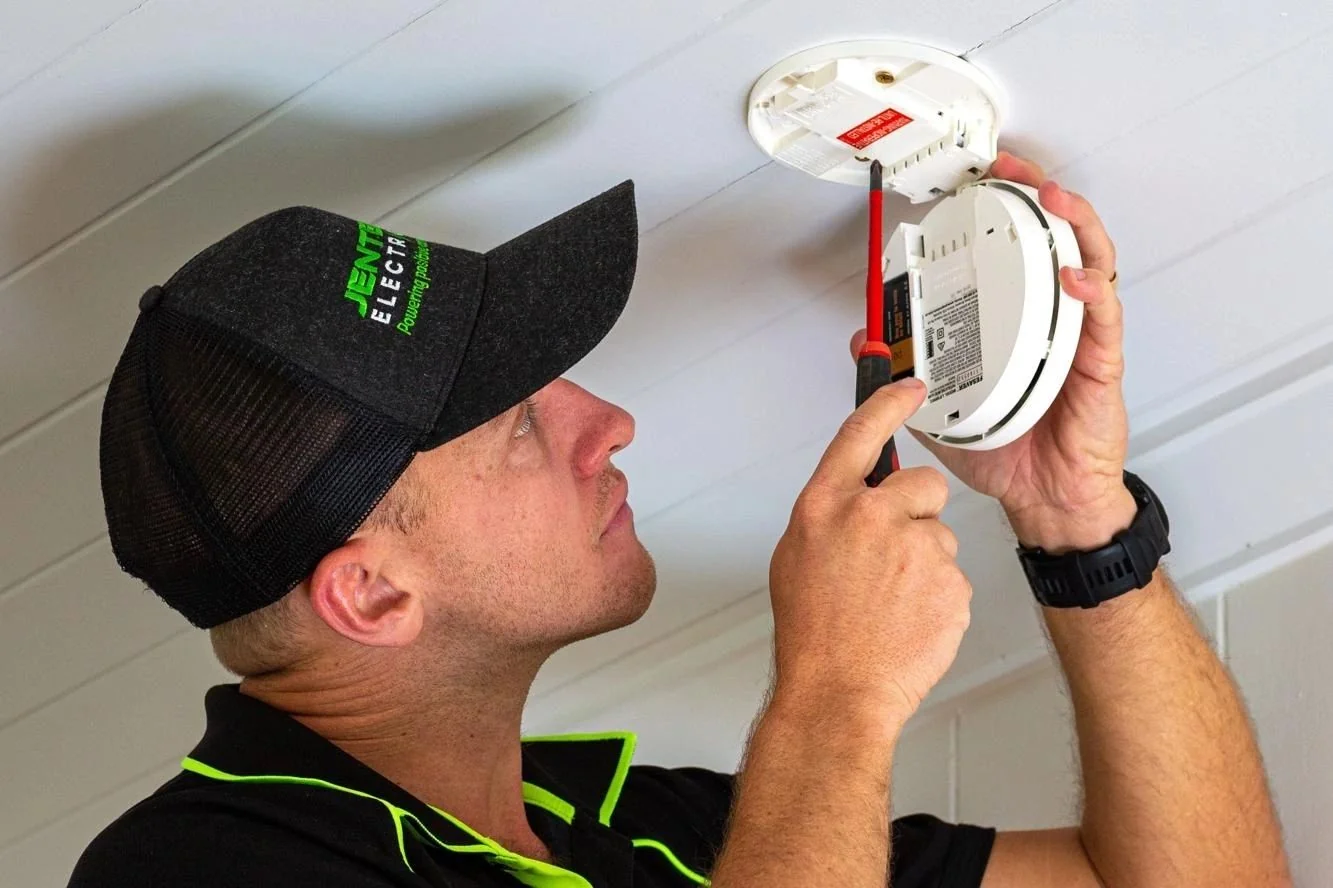
If you own a home in Queensland, you have a legal deadline coming up. From 1 January 2027, every owner-occupied dwelling in QLD must have interconnected photoelectric smoke alarms in every bedroom, every hallway that connects bedrooms, and on every storey. Rental properties have already had this requirement since 2022. Homes being sold or leased must be compliant at the point of transaction, regardless of the 2027 date.
In plain language: if you own your home, you have until 1 January 2027 to upgrade. Most Brisbane homes we visit aren't yet compliant. Here's what the law actually requires, why Queensland is stricter than any other state, and what the upgrade costs.
The five-line summary
- •Every bedroom needs its own alarm.
- •Every hallway connecting bedrooms needs an alarm.
- •Every storey of the home needs at least one alarm (even if there are no bedrooms on that storey).
- •All alarms must be photoelectric type (ionisation alarms are banned in QLD as of 2022).
- •All alarms must be interconnected — when one sounds, they all sound.
Alarms must also either be hardwired to mains power with a backup battery, or have a non-removable 10-year sealed lithium battery. 9V battery-only alarms no longer meet the standard.
Why Queensland has stricter rules than other states
The Queensland law was strengthened in response to the 2011 Slacks Creek house fire, in which 11 people died — the largest residential fire loss of life in Australian history. An independent review identified that compliant smoke alarms could have saved lives. The state government progressively tightened the law from 2017, with the final stage — owner-occupied homes — landing on 1 January 2027.
Other Australian states have similar but less strict rules. Queensland's requirement for interconnected alarms in every bedroom and the banning of ionisation alarms goes further than NSW, Victoria, or most other jurisdictions.
What 'interconnected' actually means
When any one alarm detects smoke, every alarm in the home must sound simultaneously. This is critical in the bedroom-to-kitchen scenario: a fire starting in the kitchen at night needs to wake people asleep in bedrooms down the hall. Without interconnection, the person closest to the fire is often the last to know.
Interconnection can be hardwired (alarms physically connected by a low-voltage signal wire) or wireless (RF signalling between compliant alarm heads). Both are acceptable under the law. Hardwired is typically cheaper and more reliable for new installs during a renovation; wireless is easier for retrofits into finished homes where running extra cable would require ceiling access.
Why photoelectric — and why ionisation was banned
Photoelectric alarms detect the large smoke particles produced by smouldering fires — the most common type of residential fire, and the type most likely to give people time to escape. Ionisation alarms are better at detecting fast-flaming fires (like a pan on a stovetop) but are notorious for nuisance-tripping on burnt toast and steam, which leads homeowners to disable them — defeating the entire purpose.
Queensland Fire and Emergency Services pushed for a photoelectric-only rule based on fire investigation data showing photoelectric alarms saved more lives. Since 2022, new installs of ionisation alarms have been banned in QLD. Any existing ionisation alarms in your home must be replaced as part of the 2027 compliance upgrade.
Who has to comply, and when
Rental properties — already in force (since 2022)
If you rent out a property in Queensland, it must already be compliant. Your property manager should be arranging annual compliance inspections. If they're not, that's a gap you need to address — non-compliance can affect your landlord insurance coverage and exposes you to liability in the event of a fire.
Sale or lease trigger — already in force
A property being sold or leased must be compliant at the point of transaction. This catches homeowners who haven't upgraded yet — if you're selling in 2026, you need to be compliant before settlement. Smart sellers upgrade before listing, because non-compliance becomes a negotiation lever for buyers.
Owner-occupied homes — 1 January 2027
If you own and live in your home and haven't yet upgraded, 1 January 2027 is your deadline. In practice, we recommend not leaving it to late 2026 — the compliance trade is going to be busy, pricing will firm as availability tightens, and you'll save money and hassle by booking in a quiet window.
Who pays — owner, landlord, or tenant?
This is the question we get asked most by people who own an investment property or live in a rental. The short version: whoever owns the dwelling pays for compliant alarms — never the tenant.
- •Owner-occupier: you pay. It's your home and your deadline is 1 January 2027.
- •Landlord: the property owner pays for supplying, installing and maintaining compliant interconnected photoelectric alarms — and for the compliance check within 30 days before the start of every new or renewed tenancy. This is not a cost you can pass to the tenant.
- •Tenant: you're only responsible for replacing a flat removable battery during the tenancy and for not tampering with or removing an alarm. If a sealed or hardwired alarm fails, that's the owner's repair.
For units and townhouses, it splits by where the alarm sits. Alarms inside your lot are almost always the lot owner's responsibility; alarms in common property (shared stairwells, lobbies) are the body corporate's. If you're unsure, the community management statement or by-laws will say — and we can advise on the boundary during the audit.
What compliance typically costs for a Brisbane home
Costs vary with bedroom count and whether existing alarm cabling can be reused. Based on hundreds of QLD home upgrades:
- •Single hardwired photoelectric alarm installed: $180 – $250
- •3-bedroom home compliance package: $450 – $850
- •4-bedroom home compliance package: $650 – $1,100
- •5-bedroom / 2-storey home: $850 – $1,500
- •Rental compliance inspection: from $150 (written certificate included)
- •Annual service: from $120 per home
A compliance package typically takes a single day for a 3-bedroom home. The technician arrives with the alarms and cabling, isolates power, installs the units to Australian Standard AS 3786 spacing, interconnects them (hardwired or wireless depending on existing infrastructure), and runs an interconnection test — triggering each alarm in turn to confirm all others respond. On completion you receive a written compliance report.
The common mistakes we see
- 1.Assuming new alarms from the hardware store are compliant. Many aren't — they're ionisation or non-compliant photoelectric. Check the face for 'AS 3786' markings.
- 2.Leaving one bedroom out 'because nobody sleeps there'. The law applies to every bedroom in the dwelling, regardless of current occupancy.
- 3.Using battery-only alarms without a 10-year sealed lithium cell. Standard 9V battery alarms are no longer compliant.
- 4.Skipping the interconnection test. We see homes where someone has installed the right alarm heads but wired them as standalone. If one goes off and the others don't, you're not compliant.
- 5.Leaving it until December 2026. Compliance tradespeople will be booked out. Pricing firms as availability shrinks.
What to do next
Book an audit. For a Brisbane home, a compliance audit takes 15–20 minutes — we walk the home, count bedrooms and storeys, check existing alarms for compliance markings, and give you a fixed-price quote the same or next day. No obligation; audits are free for owner-occupied homes.
If your home needs an upgrade, we'll schedule the install — most 3-bedroom homes completed in a single day. You'll end up with a compliant, properly-tested system and a written compliance report you can keep on file.
Bring your QLD home into compliance ahead of 2027
SEE SMOKE ALARM SERVICES