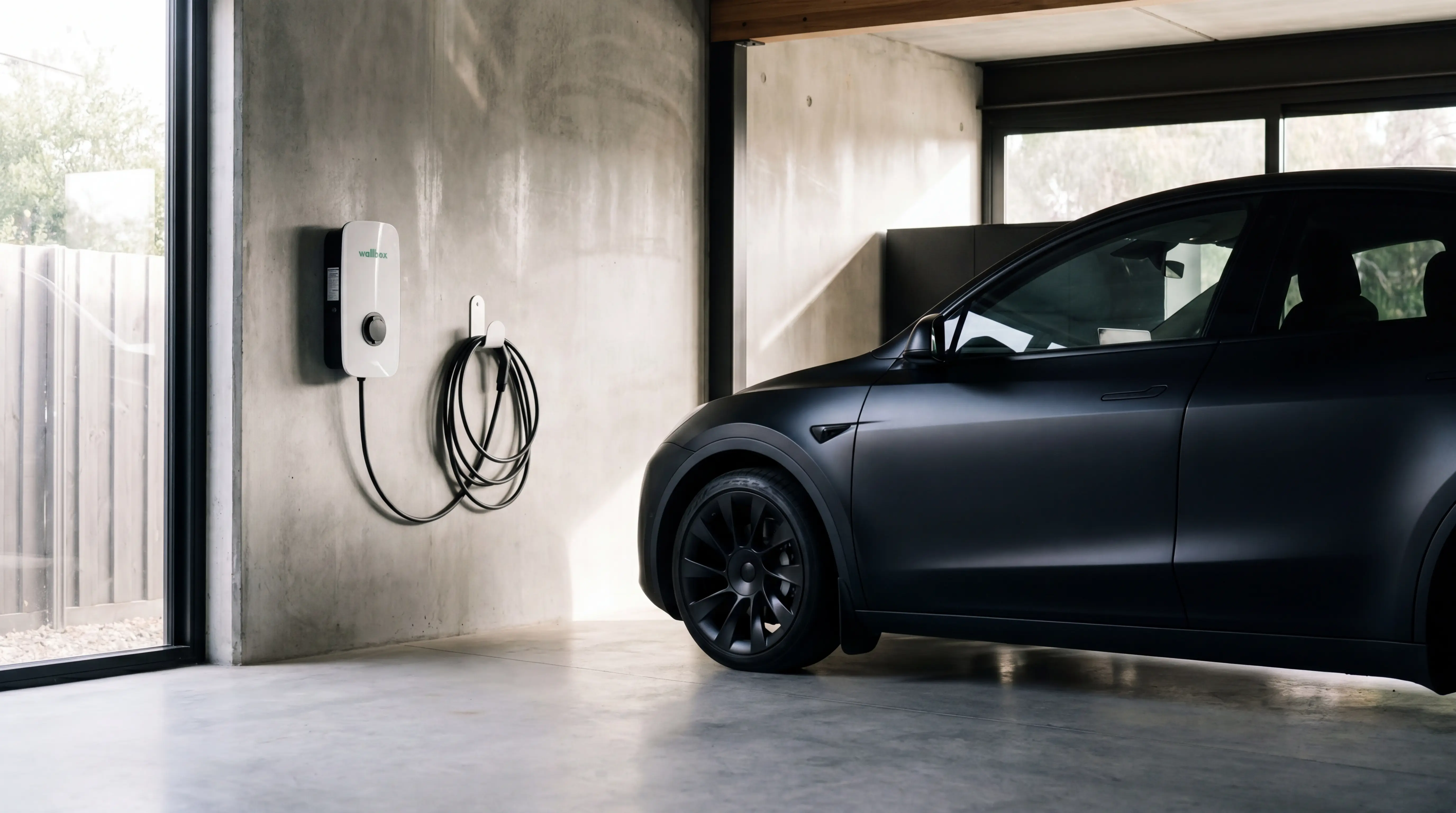
EV ownership has grown rapidly across Queensland, and most Brisbane owners charge at home rather than at public stations — home electricity is materially cheaper per kWh, more convenient (plugged in overnight), and often eligible for off-peak tariffs that push effective charging cost lower still.
If you're joining that group, you have three home charging options, and the middle one is what most Brisbane households actually need. Here's the guide.
The three levels of EV charging
Level 1 — Standard 10A power point (granny charger)
Every EV sold in Australia comes with a portable charger that plugs into any standard 10A power point. Charging rate: about 10–15 km of range per hour. For a Tesla Model Y or BYD Atto, a full charge takes 30–40 hours from empty. Practical for plug-in hybrids (smaller batteries) or drivers covering under 50km a day. For most new pure EVs, it's a workable trickle charge but not the primary plan.
Level 2 — Dedicated AC charger (7kW or 22kW)
A hardwired home charger on a dedicated circuit. 7kW is single-phase (roughly 40–50 km of range per hour); 22kW is 3-phase (roughly 120 km per hour). This is what most Brisbane households install — fast enough for a full charge overnight, well-matched to solar and battery systems, and typically $850–$2,800 installed depending on distance from the switchboard and phase type.
Level 3 — DC fast charging (50kW+)
The high-speed chargers at service stations and shopping centres. DC fast chargers are commercial-grade, typically cost $30,000–$60,000 to install, and require significant supply capacity. Not residential. If you see someone quote 'DC fast charger home install' for under $10,000, it's not actually a DC charger.
Single-phase vs 3-phase — which one do you need?
Most Brisbane homes are single-phase (one live conductor supplying the house from Energex). Many inner-Brisbane premium homes and any home that's had a recent renovation with ducted A/C and EV provision are 3-phase (three live conductors, enabling higher continuous loads).
The difference matters for EV charging:
- •Single-phase: maximum charger rate is 7.4kW (32A × 230V). Delivers about 40 km of range per hour. Full charge from empty in 8–10 hours for most EVs. Perfect for overnight charging.
- •3-phase: maximum charger rate is 22kW. Delivers about 120 km of range per hour. Full charge in 3–4 hours. Overkill for most households, but useful if you have multiple EVs, drive long distances daily, or intend to feed a vehicle-to-grid system.
Our recommendation for most Brisbane households: a 7kW single-phase charger is plenty. A 22kW 3-phase charger only makes sense if you already have 3-phase supply (or were planning to upgrade anyway for ducted A/C or similar) and genuinely drive enough to justify it. The price difference for the charger itself is modest ($150–$400); the price difference for the supply upgrade is not ($4,000–$12,000 all-in if you're going from single-phase to 3-phase, including the new board).
Load management — essential if you have solar, battery, or multiple EVs
A 7kW charger running at full rate plus a ducted A/C system plus a hot water element plus a kitchen-peak-hour cooking load can exceed what a typical Brisbane home's supply can deliver simultaneously. Without load management, the result is a tripped main breaker at an inconvenient moment.
Load-managed chargers monitor the total household draw in real time and throttle the EV charge rate to keep the house within supply capacity. Brands like JET Charge, Ocular, and Wallbox Pulsar Plus include load management natively. We commission the load limit during installation and test it.
For households with solar, some load-managed chargers can also prioritise EV charging from surplus solar — so when the panels are producing more than the house is using, the excess feeds the car instead of exporting to the grid (where the feed-in tariff is often 5c/kWh vs the retail rate of 30c/kWh). This is a material cost saving over years of ownership.
Coastal-proofing for river-adjacent and coastal Brisbane
Homes in Bulimba, Hamilton, Teneriffe, New Farm, and anywhere close to the Brisbane River or the coast pick up more salt-air exposure than inland suburbs. Standard residential-grade chargers mounted in outdoor garages or carports will corrode internally over 3–5 years in these environments.
The fix is straightforward: specify an IP54 or IP66-rated charger (most quality brands meet this by default), install it in a marine-grade or stainless-housing enclosure if it's fully exposed, and use stainless-steel cable glands and fixings. Adds $150–$300 to the install; adds 15+ years to service life.
What a Brisbane EV charger install actually involves
- 1.Site visit: confirm supply (single or 3-phase), switchboard capacity, charger location, cable run distance.
- 2.Written quote with recommended charger model and any necessary board work or load management configuration.
- 3.Install day: dedicated circuit run from the switchboard to the charger location, usually $120–$180 per metre of cable run (most installs 6–15 metres).
- 4.Circuit RCD-protected (legal requirement for EV circuits under AS/NZS 3000 appendix C).
- 5.Charger mounted, connected, and commissioned to manufacturer spec.
- 6.Load limit set and tested. Network card configured if applicable.
- 7.Certificate of Electrical Safety issued. 12-month workmanship warranty.
Typical cost ranges
- •7kW single-phase charger, <10m cable run, existing supply adequate: $850 – $1,400 installed
- •7kW single-phase charger, longer cable run or trenching required: $1,400 – $2,000
- •22kW 3-phase charger, supply capacity adequate: $1,600 – $2,800
- •Pre-wire only (during renovation, no charger installed yet): $850 – $1,400
- •Load-managed charger with solar integration: add $200 – $500
- •Marine-grade enclosure for coastal installs: add $150 – $300
- •Switchboard upgrade if required: $1,800 – $3,500 (see our dedicated guide)
Book a Brisbane EV charger install or quote
REQUEST AN EV CHARGER QUOTE