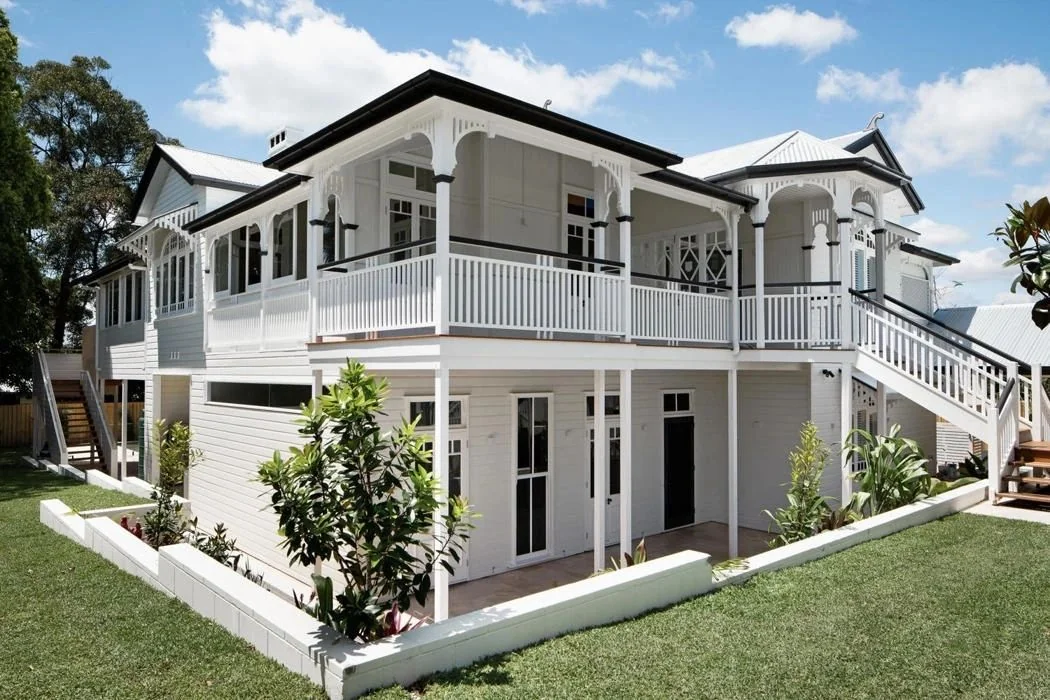
Queensland's character home stock is one of Australia's most recognisable architectural treasures — and one of the most electrically aged. Brisbane's inner suburbs — Paddington, Red Hill, Wilston, West End, Bulimba, Bardon — are full of Queenslanders built between 1900 and 1950 that have been partially modernised over the decades, but which still carry significant original or early-renovation-era electrical wiring below the floorboards and above the ceilings.
That wiring — typically rubber-insulated VIR (vulcanised indian rubber) or early TPS (tough plastic sheathed) cable — has a rated service life of about 30 years. The cable installed in a 1955 home is now 70 years old. The cable installed in a 1985 renovation is 40 years old. Both are well past safe service life and both fall short of current AS/NZS 3000:2018 compliance.
This guide walks through seven signs your Queenslander is due a rewire, what the work actually involves, and how we approach preserving the heritage features that make these homes worth owning in the first place.
The seven warning signs
1. The switchboard still has ceramic fuses
Open the switchboard door and look for small white ceramic cylinders with a screw-top. That's a rewireable ceramic fuse — the technology the world moved on from in the 1970s. A ceramic-fuse board almost always means the rest of the wiring is of a similar era. It's also your single clearest indicator that a rewire should be on the near-term horizon.
2. No RCD safety switches
Modern switchboards have RCDs — Residual Current Devices, recognisable by red or green 'TEST' buttons on multiple switches. These cut power within milliseconds if they detect current leaking to earth (what happens when a person touches a live wire). If your board doesn't have these, you have no electric-shock protection on most of the home's circuits. Adding RCDs to an older board is rarely a clean retrofit — it usually leads to a board upgrade, which usually leads to a rewire discussion.
3. Circuits trip or fuses blow under normal load
A circuit that trips when the kettle, toaster, and dishwasher run simultaneously isn't necessarily a wiring fault — it might be undersized cable or overloaded circuits. But frequent, unexplained trips (especially without an identifiable cause) often indicate insulation breakdown on the cable itself. Rubber-insulated wiring degrades from the inside out and eventually develops earth faults that trip under normal use.
4. Flickering lights not caused by LED dimmers
LED lighting with incompatible dimmers flickers on its own — that's a lighting problem, not a wiring problem. But if traditional incandescent or halogen lights flicker, or if multiple rooms dim momentarily when an appliance starts, that usually indicates a loose connection or a failing neutral somewhere in the circuit. In older wiring, these develop as the cable and its terminations age.
5. Warm or discoloured outlets and switches
A power point or light switch that feels warm to the touch under normal use is a red flag. So is discolouration (yellowing or browning of the plastic faceplate). Both indicate heating at the connection — which in turn indicates loose terminals, oxidised wire, or insulation breakdown. This isn't something to monitor; it's something to have inspected promptly, because heating connections cause house fires.
6. Cloth-covered or rubber-sheathed cable visible in the roof
If you can access the roof cavity or under the floor, you can often see the cable itself. Modern cable is white PVC-sheathed (typical TPS). Older installations show cable sheathed in cloth, rubber, or lead. Any of those are indicators that the wiring is pre-1970s. The insulation may still be holding up, but the service life is exhausted.
7. Renovation or appliance additions being quoted with a 'board upgrade required' line
If you've recently had an A/C installer, EV charger installer, or renovation electrician tell you 'the switchboard needs upgrading before we can add this circuit', that's not them upselling — it's the AS/NZS 3000 renovation trigger rule. And it's often the prompt that makes homeowners confront the broader wiring age question.
What a Queenslander rewire actually involves
A full rewire replaces every circuit in the home — power, lighting, stove, hot water, air conditioning, fans — with new TPS cable routed through the ceiling cavity, wall cavities, and under the floor, terminating in a new switchboard with RCD protection on every circuit. Every GPO, switch, and light fitting is replaced or reused depending on condition. Every smoke alarm is brought up to 2027 compliance.
Staged, not shut-down
A full Queenslander rewire typically takes 5–7 working days total — 3–5 days for the rough-in (the cable routing) and 2–3 days for the fit-off (outlets, switches, fittings, testing). We stage the work room-by-room so the kitchen, main bathroom, and main bedroom stay functional throughout. Families can usually stay in the home for the duration.
Preserving heritage features
This is where a heritage-competent electrician differs from a generalist. Queenslanders routinely have pressed metal ceilings, VJ timber wall linings, stained glass windows and internal doors, and original timber floors with valuable patina. Drilling through any of these without planning is how heritage damage happens.
Our approach: cable routes are planned to use existing chases, top-of-wall runs behind the cornice, and under-floor drops where accessible. Pressed metal is taped and protected before any drilling; we use bi-metal hole saws at low speed to avoid cracking. Stained glass rooms are done by hand — no vibration transmission. Original pendant fittings are unhung, rewired on the bench (cloth-covered flex replaced with modern but period-correct cable), and rehung.
Typical cost ranges for a Brisbane Queenslander rewire
- •Partial rewire (2–3 bedroom character home): $8,000 – $14,000
- •Full Queenslander rewire (4–5 bedroom, including switchboard upgrade): $18,000 – $30,000
- •Larger heritage rewire with full lighting redesign: $30,000 – $60,000+
- •Switchboard upgrade only (if wiring is less aged): $1,800 – $3,500
Cost variation comes from: bedroom count, switchboard location, heritage overlay constraints (Paddington, West End), whether any pendants or features need rewiring individually, and whether we're bundling it with a broader renovation.
Heritage overlays (Paddington, West End, parts of Fortitude Valley)
If your home sits in Brisbane City Council's Traditional Building Character overlay, you have external constraints on what can be visible from the street — meter box placement, conduit runs on front-facing facades, visible solar panels, and EV charger hardware. Internal rewiring is unaffected by the overlay, but the meter and switchboard location may need careful planning for any external work.
See our suburb pages for Paddington, West End, and other character suburbs for more on the overlay rules and how we plan around them.
Not sure if your Queenslander needs a rewire?
BOOK A SAFETY INSPECTION